

The core difference: a written prompt vs. an analysed clip
Both tools generate music with a model. The difference is what the model knows about your video, and the answer for Suno is: nothing. You type a style, a mood, maybe lyrics, and Suno composes a song to that description. It is very good at it, and it is why Suno's plans are counted in songs: Pro gives 2,500 credits a month, "up to 500 songs" by Suno's own arithmetic. The song is the output.
ReelMusic starts from the other end. The input is the clip. The app analyses what is in it and how it moves, writes the brief itself, and composes a track that fits that brief. You see the brief before anything is generated, in one plain sentence, so you know the app understood the footage:
Neither approach is better in general. They are answers to different questions. "I want a song that sounds like this" is Suno's question. "I have this video, give me music for it" is ReelMusic's.
What the video analysis picks up that a prompt does not
When a business owner writes a prompt for a Reel, four things usually go missing, because they are hard to put into words and easy to see:
- Pace. A slow pan across a dining room and a three-second-per-shot gym montage need different tempos. The analysis measures the cut rhythm; a prompt guesses at "upbeat".
- Cuts and reveals. Before-and-after formats, unboxings and room tours have a moment. A track composed to the clip has somewhere to put the swell, and the positioning step lets you land it.
- Mood as it actually is. Footage is often calmer or warmer than the words a busy person types. The analysis reads colour, motion and content rather than intent.
- Length. A 19-second Reel needs a track that is about 19 seconds long and ends cleanly. A prompt does not know the clip is 19 seconds; you find out when you trim.
What a prompt does better: specificity. If you know you want "a 1980s synth-pop chorus in a minor key with a female vocal", a prompt is the right tool and no video analysis will get you there. ReelMusic's steering is deliberately coarse, five vibes and a "safe to surprising" slider, because its user is a café owner, not a music director.
Length and timing: matching a 20-second clip exactly
Suno
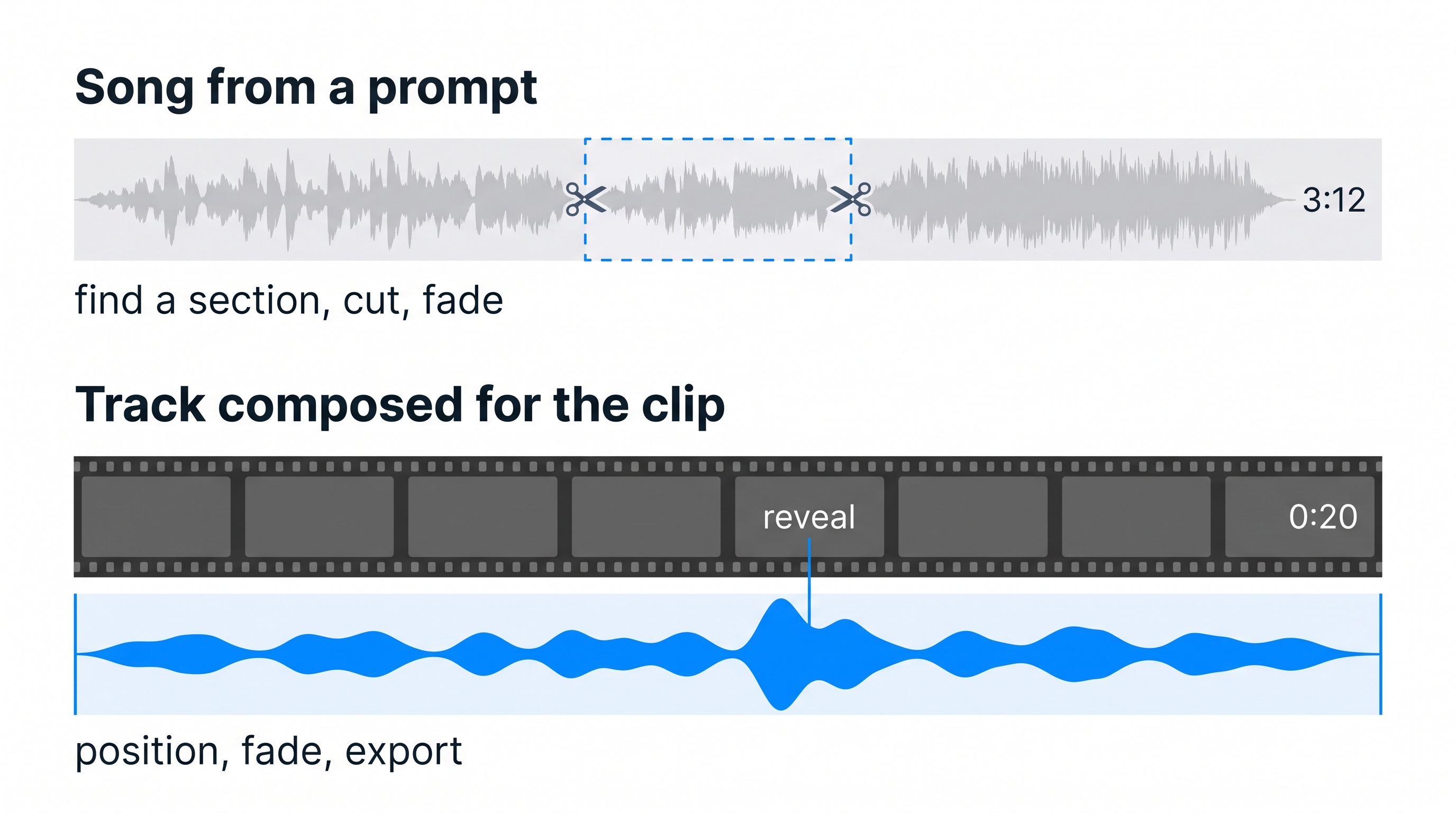
Generates a full song, typically minutes long, with an intro, verses, a chorus and an ending. For a 20-second Reel you download it, open an editor, find the section that works, cut it, and fade the cut so the song does not stop mid-phrase. The song's strongest moment is wherever Suno put it, which is rarely where your reveal is.
ReelMusic
Composes a track for the clip's length. In the studio view you drag the track against the filmstrip so the drop lands on the cut, pull the fade handles, and balance the music against the original sound. The preview is the export: what you hear is exactly what ends up in Photos.
An honest note on both. Suno's songs are musically richer: real song structure, vocals, stems on paid plans. ReelMusic's tracks are instrumental beds built to sit under a video; nobody will stream one for pleasure, and that is the point.
Commercial rights on each plan, and what a business account needs
| Question | Suno | ReelMusic |
|---|---|---|
| Free tier | "No commercial use." Terms: outputs only for "lawful, personal and non-commercial purposes". | Free-plan tracks are for private, non-commercial use and evaluation only |
| Paid plans | Pro $8/mo ($6.40 annual), Premier $24/mo ($19.20 annual): "commercial use rights for new songs made". Suno assigns its rights in the output to you. | Any paid plan: worldwide, perpetual, royalty-free, non-exclusive commercial licence, including ads and client work |
| Songs made before upgrading | Stay personal-use only; rights apply to songs made while subscribed | Same principle: the licence attaches at generation on a paid plan |
| After you cancel | Rights in songs made while subscribed are kept | Tracks generated on a paid plan stay licensed |
| Ownership | "Suno makes no representation or warranty to you that any copyright will vest in any Output" | A use licence, not ownership; the terms note that purely AI-generated music may not be copyrightable |
| Exclusivity | Not guaranteed | Non-exclusive |
| Content ID, streaming release | Streaming release of paid-plan songs is a common Suno use; check the current terms for distributor rules | Not allowed: no Content ID or GEMA registration, no standalone release, no resale |
| Downloads and remixes | Commercial use requires an approved download under the plan; remixes stay personal-use | Export is the finished video with the track mixed in |
For a business account, both paid plans work on paper. The practical differences are two. Suno's rights are per song made while subscribed, so a shop that generated its jingle on the free plan and upgraded a month later has a personal-use jingle; it has to be regenerated. And Suno's ownership disclaimer is worth reading twice: it is not a defect, it is the state of the law, and it applies to every generator including ours. The US Copyright Office concluded in January 2025 that purely AI-generated material is not copyrightable, so what you get from any of these tools is the right to use the output, not a song you can stop others from using.
The training-data lawsuits, in one paragraph
In June 2024 the three major labels sued Suno (and Udio) over the music used to train their models. Since then the picture has split: Warner Music settled with Suno, announced on 25 November 2025 and dismissed on 28 January 2026, while Universal and Sony continue the Massachusetts case, with fact discovery due on 30 September 2026. In Germany, the Munich Regional Court ruled against Suno in a case brought by the collecting society GEMA on 31 July 2026. None of this targets people who use Suno's songs; the claims are about training. But it matters in two ways for a business: the models and terms you rely on could change with a ruling, and in Germany specifically the GEMA decision is the kind of thing a warning-letter firm reads. ReelMusic generates through providers under commercial agreements that assign or license the output to us, and we say so in our terms; we do not claim more than that.
Where Suno is the better choice
Choose Suno if you
- Want a song: vocals, lyrics, a chorus, a hook. ReelMusic does not do vocals at all.
- Are making music as the product: a brand jingle, a podcast theme, an artist project, a release.
- Need long tracks, stems or remixing tools.
- Know exactly what you want and can describe it; a prompt beats an analysis for specificity.
- Generate at volume: Pro's 2,500 credits a month is up to 500 songs for $8.
- Work on a desktop or on Android.
Choose ReelMusic if you
- Have a video and need music for it, not the other way round.
- Post Reels, TikToks and Shorts from a business account and want the track to fit the clip's length and cuts.
- Do not want to write prompts or trim songs in an editor.
- Want the whole loop on an iPhone, from Photos back to Photos.
- Want a licence that explicitly covers ads and client work and survives cancellation.
- Would rather have a track nobody could ever claim than a song you cannot fully own either.
Verdict table
| What matters for a business account | ReelMusic | Suno |
|---|---|---|
| Composed for your specific video | ✓ Watches the clip | ✕ You describe it in words |
| Safe to post from a business account | ✓ Every paid-plan track | ~ Pro and Premier songs; free-plan songs are personal-use only |
| Fits the length and cuts of the clip | ✓ Timed to the video, positioned by you | ✕ Trim in another app |
| No prompt writing or music knowledge | ✓ One tap | ✕ Genre, tempo, mood, lyrics by hand |
| Vocals and lyrics | ✕ | ✓ |
| Where it happens | On your iPhone, video to export | Generate, then your editor |
| Cheapest plan with commercial rights | Monthly $14.99; Yearly $99.99 | Pro $8/mo, $6.40 on annual billing |
| Licence survives cancellation | ✓ | ✓ For songs made while subscribed |
| Training-data litigation | Providers under commercial agreements; no public litigation | Universal and Sony ongoing; Warner settled; Munich GEMA ruling July 2026 |
FAQ
Can I use Suno songs on a business account?
Songs made on Suno's Pro or Premier plans come with commercial use rights; Suno's terms assign its rights in the output to those subscribers. Songs made on the free plan are for personal, non-commercial use only, and upgrading later does not change that for songs already made.
Does Suno make music that fits my video's length?
Suno generates songs from a text prompt without seeing the video. You download the song and trim it to the clip in an editor. ReelMusic reads the clip and composes a track to its length and pace, then lets you position it.
Who owns a Suno song?
Suno assigns its rights in the output to Pro and Premier subscribers, but states that it makes no representation or warranty that any copyright will vest in any output. In the United States, purely AI-generated material is not copyrightable according to the Copyright Office's January 2025 report. The same applies to ReelMusic tracks: you get a licence to use them, not a copyright.
Is the Suno lawsuit a risk for my business?
The remaining label claims are about how Suno trained its models, not about individual users' songs. Warner settled in 2025; Universal and Sony continue in the Massachusetts case, and a Munich court ruled against Suno in a GEMA case in July 2026. Nothing in the public record targets end users, but the outcome could change Suno's models and terms.
Can I put lyrics or vocals in a ReelMusic track?
No. ReelMusic composes instrumental soundtracks for video. If you need a song with vocals, Suno is the better tool.