
Every song carries two copyrights
Most confusion about music rights comes from one fact that download pages never mention: a recorded song has two separate copyrights. The composition (melody, harmony, lyrics) belongs to the songwriter and their publisher. The sound recording (this particular performance, captured in this particular file) belongs to whoever paid for the recording, usually a label or the artist. To put a song in a video you need permission from both sides, because a video "synchronises" the recording and the composition with pictures at the same time.
This is why "the song is 200 years old" does not make a recording free. Beethoven's composition is public domain. The Berlin Philharmonic's 2019 recording of it is not. It is also why a cover version does not escape a claim: the recording is new, but the composition is still the original writer's.
Royalty-free: you still need a licence, you just do not pay per play
"Royalty-free" is a pricing model, not a rights status. In traditional licensing you pay a royalty each time the music is used or played. In royalty-free licensing you pay once, or you pay a subscription, and you can use the track as often as the licence allows without further payment. The copyright is fully intact. The library, or the composer behind it, still owns the track and can still stop uses that fall outside the licence.
Three limits show up in almost every royalty-free licence, and all three matter for a business account:
- Scope. Most libraries sell a personal plan and a commercial plan. Epidemic Sound's Creator plan covers personal content on one channel per platform and excludes client work and digital ads; client work and ads need the Pro plan. Artlist's Social plan "does not cover client projects", while its Pro licence covers "client work, paid ads, websites, podcasts, broadcast and TV". A business account posting on the personal plan is outside the licence even though it paid.
- Time. Subscription licences are tied to the publication date. Epidemic Sound's help centre says content "published during an active subscription will stay cleared to monetize forever", but that videos published with its music after the subscription ends will be monetized by Epidemic Sound, meaning it claims them. Artlist's terms work the same way: finished projects stay licensed, new projects after the plan ends do not.
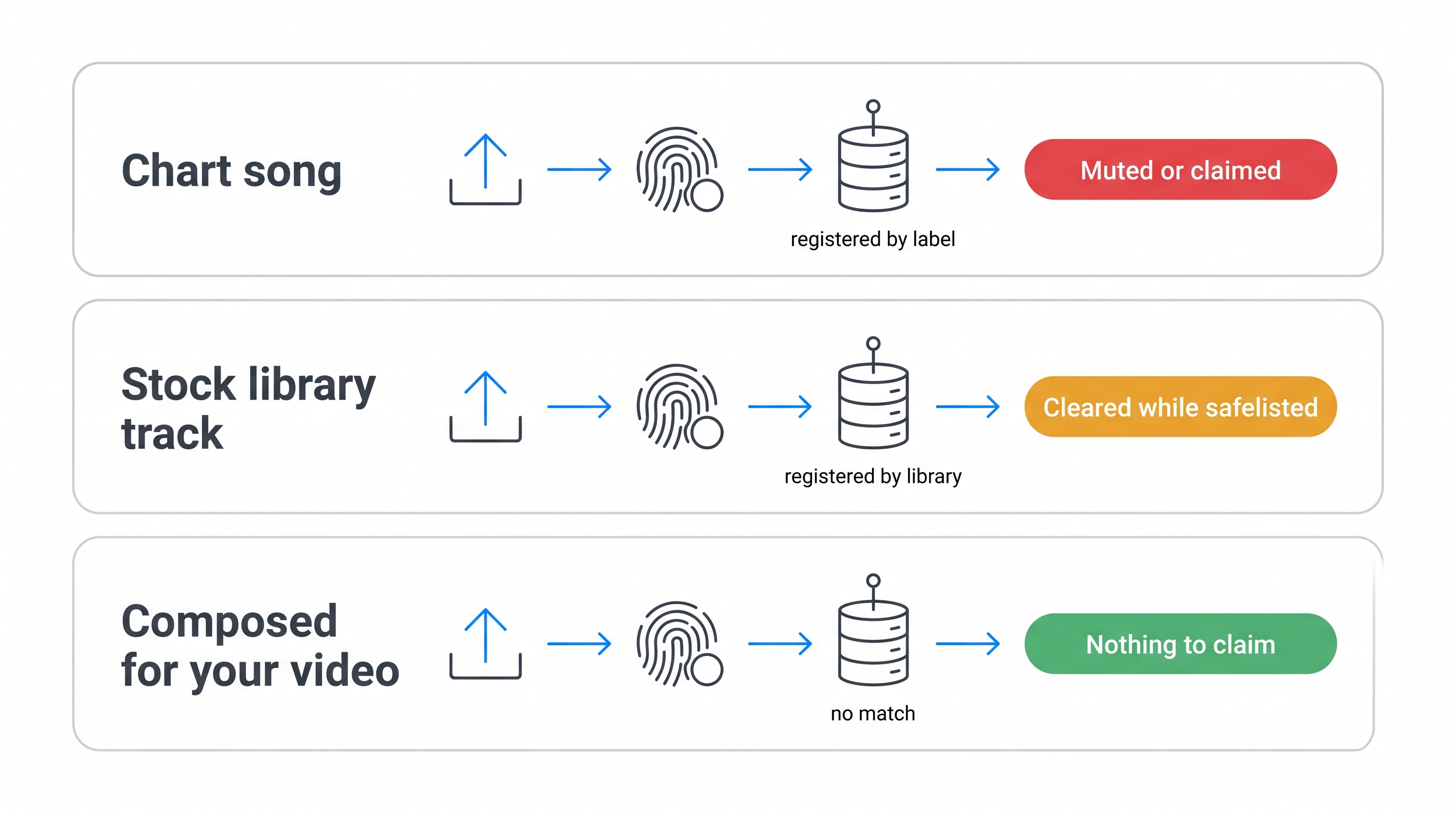
- Channels. Libraries protect you from Content ID claims by safelisting your registered channels. A video posted from an unregistered account, or a client's account you forgot to add, can be claimed even though the music is licensed.
None of this makes royalty-free music a bad deal. It makes it a deal with terms, and the terms are what decide whether your business account is covered.
Copyright-free and public domain: rare, and rarely what is on offer
True copyright-free music exists in two forms. Public domain works are compositions whose copyright has expired, generally 70 years after the composer's death in the EU and the UK. CC0 is a legal tool with which a creator waives all rights in a work. Both are real, and both are narrow: for a public domain composition you still need a public domain or CC0 recording, and very few professional recordings are released that way.
What is usually sold as "copyright-free" or "no copyright music", especially on YouTube channels and free download sites, is something else: royalty-free music under a licence, or Creative Commons music with conditions, relabelled to rank for the search term. YouTube itself draws the line in its Audio Library help page: "YouTube is not responsible for issues that arise from 'royalty-free' music and sound effects from YouTube channels or other music libraries." If a channel you have never heard of promises a chart-quality track with no strings, assume the strings are simply not shown.
Creative Commons: the fine print that excludes businesses
Creative Commons licences are free to use but not free of conditions, and one condition is aimed straight at business accounts. CC BY allows any use, including commercial, as long as you credit the creator in the way the licence describes; YouTube's Audio Library uses this for part of its catalogue and says "you must credit the artist in your video's description". CC BY-NC adds "NonCommercial", which excludes exactly the posts a business account makes. CC BY-SA requires you to release your own video under the same licence, which almost no business wants. Before using a CC track, read the two letters after "BY". They are the whole licence.
Cleared for commercial use: what has to be true
"Cleared" is the word the music industry uses when every rights holder has agreed to a specific use. It is a statement about a deal, not about a file, and four things have to be true for it to hold:
- Someone holds the rights, or stands in for them. A library that licensed the tracks from composers, a label licensing its own catalogue, or a generator whose provider contract assigns or licenses the output.
- The licence covers your use. Commercial use, on your platforms, in paid ads if you run them, for client work if you deliver it. "Commercial" alone is not enough if ads or broadcast are carved out and you need them.
- The licence covers you. The account, the company, the client. A freelancer's personal plan does not clear the client's business account.
- You can prove it. A licence certificate, an invoice with the plan name, a generation record. When a platform raises a claim or a law firm writes, the proof is what ends the conversation.
On the platforms themselves, "cleared" has a narrow built-in form. The Meta Sound Collection and TikTok's Commercial Music Library are cleared for commercial use on that platform only; CapCut's Materials License Agreement states that commercial sounds may be used "within CapCut, TikTok and TikTok for Business" and that anything else requires a separate licence from the rights holders. The business-account explainer goes through those libraries in detail.
Where AI-generated music sits
Generated music adds a twist to all three terms. In January 2025 the United States Copyright Office published Part 2 of its report on copyright and artificial intelligence and concluded that "copyright does not extend to purely AI-generated material, or material where there is insufficient human control over the expressive elements", and that "prompts do not alone provide sufficient control". So a track generated from a prompt is, in the US, close to copyright-free in the literal sense: nobody can register it as their own song.
That does not make it free to use. Your right to use a generated track comes from the provider's terms, and those terms vary a lot. Suno's terms of service, effective 3 September 2026, assign the company's rights in the output to Pro and Premier subscribers, restrict free-tier output to "personal and non-commercial purposes", and state that Suno "makes no representation or warranty to you that any copyright will vest in any Output". Mubert's plans up to Creator are non-commercial, and all of its tiers exclude Content ID registration and standalone streaming release. ReelMusic's terms, to use our own product as the example, grant a perpetual, worldwide, royalty-free, non-exclusive commercial licence for tracks generated on a paid plan, keep that licence alive after you cancel, and forbid registering a track with GEMA or Content ID or selling it as music on its own.
Two questions decide whether a generated track is genuinely cleared. Was the model trained on licensed data, so the output does not reproduce a real recording that a matching system could find? And does the provider stand behind the output with a licence that reaches you, the end user, including paid ads? A generator that answers yes to both gives a business account the one thing a catalogue cannot: a track that no label, publisher or library has ever registered, so there is nothing to match.
Who carries the risk in each case
| Music source | Business account covered? | Who carries the risk | What ends a dispute |
|---|---|---|---|
| Platform main library (trending sounds) | No | You. The platform terms put responsibility on the poster. | Nothing; the use was outside the licence |
| Platform commercial library (Sound Collection, TikTok CML) | Yes, on that platform | The platform, for uses inside its app | Showing the track came from the commercial library |
| Royalty-free subscription, personal plan | No | You, for any commercial post | Upgrading, and re-publishing under the commercial plan |
| Royalty-free subscription, commercial plan | Yes, while active | The library, for content published during the plan | Licence certificate with the publication date |
| Creative Commons BY | Yes, with credit | You, if the credit is missing or the uploader lied about the licence | The licence page and your attribution |
| Creative Commons BY-NC | No | You | Nothing; commercial use is excluded |
| Public domain or CC0 (composition and recording) | Yes | Nobody, if both rights are genuinely free | Evidence of the recording's status |
| AI generator, free tier | Usually no | You | Nothing; most free tiers exclude commercial use |
| AI generator, paid plan with commercial licence | Yes, within the terms | The provider, to the extent its terms say so | Generation record and the plan's licence |
Reading a music licence: the five clauses that matter
Licences are long, but for a business posting short video only five clauses change the answer. Search the document for these before you subscribe.
- Permitted use. Look for the words "commercial", "advertising" or "paid promotion", and "client". If ads are missing, boosted posts are outside the licence. If client work is missing, an agency cannot deliver the video.
- Term. Does the licence for published content survive cancellation? Epidemic Sound, Artlist and ReelMusic all say yes for content made while the plan was active. Some smaller libraries do not, and some tie the licence to keeping the account open.
- Platforms and territory. Platform-native libraries are platform-only. Most stock licences are worldwide and online-only; broadcast TV, radio and cinema are usually a separate tier.
- Channels and claims. How many channels can you register per platform, and how does the library handle a Content ID claim? A library with a clear claim-release process saves hours. A generator should say what documentation it provides if a false match happens.
- Exclusions. Almost every licence forbids reselling the music, adding it to another library, registering it with Content ID or a collecting society, or releasing it as a standalone song on streaming services. These are normal and not a problem for video use, but they tell you the licence is a use licence, not ownership.
Checklist before you post
- The licence names commercial use, and names ads if you plan to boost the post.
- The plan level matches the account: business, brand or client, not "personal channel".
- The channel or account posting the video is registered with the library, or the licence does not require it.
- The video will be published while the plan is active, and you know what the licence says after cancellation.
- If the track is Creative Commons, you have read the letters after "BY" and added the credit.
- If the track is AI-generated, it was made on a plan that includes commercial use, from a provider that states its training data is licensed.
- You have saved the proof: licence certificate, invoice or generation record, with the date.
FAQ
Does royalty-free mean free?
No. Royalty-free means you do not pay a fee per play or per view. You still need a licence, and most royalty-free libraries sell that licence as a subscription with a personal tier and a commercial tier.
Is copyright-free music really free of copyright?
Rarely. True copyright-free music is public domain or released under CC0, and both the composition and the recording have to qualify. Most tracks labelled copyright-free online are royalty-free tracks with a licence, or Creative Commons tracks with conditions.
Can I use royalty-free music on a business account?
Only if the licence covers commercial use. Libraries such as Epidemic Sound and Artlist sell a personal plan for individual channels and a separate pro or commercial plan for business accounts, client work and ads.
Who owns AI-generated music?
In the United States, the Copyright Office's January 2025 report concluded that copyright does not extend to purely AI-generated material. Your right to use such a track comes from the provider's licence, which is why the plan you generate it on matters.
What does cleared for commercial use mean?
That every rights holder in the track, or the provider standing in for them, has licensed the specific commercial use you are making: your platform, your account type, ads if you run them, and client work if you deliver it.