

What changes the moment you switch to Business
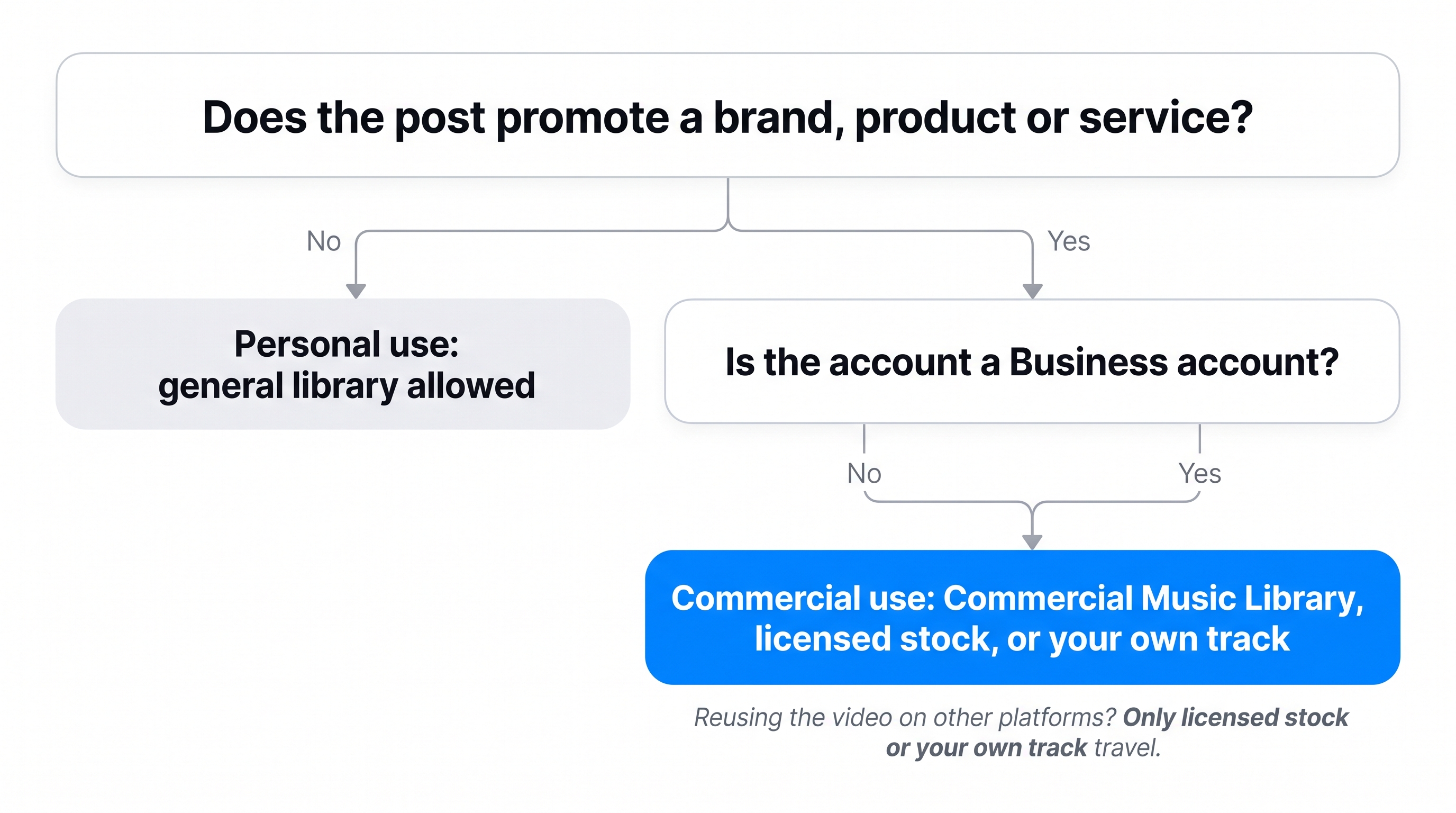
Switching a TikTok account to Business gives you analytics, a website link, ads and the business tools. It also changes one thing in the editor that most people notice only afterwards. TikTok's help centre puts it in one line: "when you use a Business Account and click on Add Sound, you will only see sounds from the Commercial Music Library". The general library, with its chart music and viral clips, is gone from the picker.
The reason is the same one that governs Instagram: TikTok's deals with labels and publishers cover personal, non-commercial use. CapCut, which shares TikTok's music catalogue and its owner, states it in its Materials License Agreement: standard sounds are for "personal entertainment and non-commercial purposes", and users "shouldn't use a Sound for any commercial purpose, including associating the music with, or promoting, a brand or business, unless you have obtained the necessary rights".
What the switch does not change: videos you posted before with general-library sounds stay online until TikTok's matching gets to them, and there is no guarantee it will not. That is the subject of the section on removal below.
The Commercial Music Library: what is in it, and what it costs you in reach
The Commercial Music Library is a real library, not a token one: a million tracks, filters that make it usable, and a licence that explicitly covers both organic posts and TikTok ads. Once a commercial sound is selected, TikTok says, "you can use them for organic or paid content". For a business that only posts on TikTok and never boosts elsewhere, it can be enough.
What it costs you is the thing TikTok is known for. Trending sounds are, almost by definition, general-library sounds: a clip goes viral, thousands of people use it, the platform surfaces videos that use it. A Business account cannot join that unless the trend happens to run on a commercial sound, which some do. We will not tell you this does not matter for reach; it does, on organic posts. What we will say is that the same trade applies to every alternative on this page, including ours: nothing cleared for commercial use is a trending sound, because a trending sound is one that everyone is allowed to use.
The second cost is scope. The Commercial Music Library licence is for TikTok. CapCut's agreement for the same commercial catalogue names the "Permitted Platforms" as "CapCut, TikTok and TikTok for Business" and says any use outside them requires you "to obtain separate permission and license the necessary rights directly from all necessary rights holders". A business that exports the same video to Instagram Reels and YouTube Shorts, which is most businesses, has a track it may use in one of three places.
Why a sound you already used can be removed later
A common complaint from business owners: the video was fine for three weeks, then the sound was muted or the post was taken down. Four mechanisms explain it, and none of them are bugs.
- Matching after publication. TikTok's audio recognition runs on published videos, not only at upload. A post that "went through" was not checked and approved; it was not checked yet.
- Classification by purpose. TikTok treats content that promotes a brand, product or service as commercial regardless of the account label. A personal account that posts a sponsored review or a product demo with a general-library sound is in the same position as a Business account.
- The account switch. Switching to Business changes what the account is allowed to use, and TikTok can apply the new rule to old videos.
- Licence changes. TikTok's deals with rights holders change; a track licensed last quarter may not be licensed this one. This is why even personal accounts sometimes find old videos muted.
The enforcement ladder runs from a muted video to a removed video to account penalties for repeat matches. Outside the platform there is a fifth mechanism: rights holders' law firms. In Germany, the firm IPPC Law has sent warning letters for music used on Instagram, TikTok and YouTube, and the published cases for Instagram, from €2,500 to over €10,000 for a single video, are collected in the Instagram guide. The mechanism is the same on TikTok: a business used a personal-use track on a commercial post.
Options for a business account, including original music
| Option | Cost | Cleared for a Business account | TikTok ads | Same video on Instagram, YouTube, website | Effort per video |
|---|---|---|---|---|---|
| Commercial Music Library | Free | Yes, on TikTok | Yes | No | Search, audition, trim in the TikTok editor |
| Stock library on a commercial plan (Epidemic Sound Pro, Artlist Pro) | From $16.99 to $24.92 a month on annual billing; $39.99 month to month on Epidemic Sound | Yes, while the plan is active | Yes, on plans that include ads | Yes | Search, download, add in an editor, trim to fit |
| Original music composed for the clip (ReelMusic, our app) | Subscription; prices in the app | Yes, on a paid plan, perpetual | Yes | Yes | Pick the clip, tap Generate, position, export |
| CapCut built-in music | Free or CapCut Pro | Commercial Sounds only, and only on CapCut, TikTok and TikTok for Business | On TikTok | No | Pick in the editor |
| No music: voice, captions, ambient sound | Free | Yes | Yes | Yes | None |
The CapCut row deserves a sentence, because CapCut is where many business TikToks are made. Its built-in music follows the same rules as TikTok's picker: standard sounds are personal-use only, commercial sounds are cleared for CapCut and TikTok and nowhere else. Editing a video in CapCut with a track from its library and then exporting it to Instagram is the most common way a business ends up with a cleared-looking video that is not cleared.
Step by step: posting with your own track
The principle is the same for a stock track or a generated one: the music goes into the video file before upload, and the post is published with its original sound. The flow with ReelMusic on an iPhone:
- Pick the clip. Open ReelMusic, tap plus, choose the video from Photos. The analysis runs on its own and shows a one-line summary of the mood, pace and cuts it found.
- Generate. Keep "Suggested" or tap Cinematic, Epic, Calm or Electronic, then Generate music. Usually about a minute.
- Position and mix. Drag the track so the drop lands on your cut, set fade in and fade out, balance the music against the original sound.
- Export to Photos. One normal video file at the original resolution, music mixed in.
- Upload to TikTok. Tap plus, choose Upload, select the file. Do not tap Add sound. The post goes out with your original sound, which the Commercial Music Library rules do not touch.
- Promote and reuse. The same file is cleared for TikTok ads and for Instagram Reels, YouTube Shorts, LinkedIn and your website, so one export covers every channel.
One practical note: TikTok re-encodes uploaded audio, so a heavily compressed export can sound thin. Export at the original resolution and let TikTok do the only compression.
FAQ
Why can I only see Commercial Sounds on my TikTok Business account?
Because TikTok's licences for the general library cover personal, non-commercial use. A Business account is commercial by definition, so TikTok limits its picker to the Commercial Music Library, which is cleared for organic posts and ads on TikTok.
Can I use Commercial Music Library tracks in TikTok ads?
Yes. TikTok's help centre states that once a Commercial Sound is selected you can use it for organic or paid content on TikTok.
Can I reuse a TikTok with a Commercial Music Library track on Instagram?
Not under that licence. The Commercial Music Library covers TikTok placements. CapCut's licence for the same catalogue states that use outside CapCut, TikTok and TikTok for Business requires separate permission from the rights holders.
Why was a sound removed from a video that was fine when I posted it?
TikTok matches audio after publication as well as at upload, classifies content by purpose, and re-checks when an account switches to Business or when its licence for a track changes. A video that went through is not proof that it was allowed.
Is original music worse for reach than a trending sound?
Trending sounds help reach on organic posts, and an original track can never be a trending sound. What original or cleared music gives a business account is a post that stays audible, can be promoted, and can be reused on every platform. Many creators keep trending sounds for personal posts and cleared music for commercial ones.